

SMS Drip Campaigns: The Complete Guide for 2026
SMS drip campaigns break down at 3 points: sequence logic, exit conditions, and contact data quality. A trigger misconfigured fires to the wrong segment. A missing exit condition sends a discount to a contact who already converted. An unvalidated list sends a drip SMS campaign sequence to landlines and disconnected numbers, wasting spend before a single message lands.
This guide covers the full setup: sequence types, trigger and exit logic, TCPA-compliant send windows, copy structure, and list validation before launch.
This guide covers the full setup: sequence types, trigger and exit logic, TCPA-compliant send windows, copy structure, and list validation before launch.
Table Of Content
What is an SMS Drip Campaign?
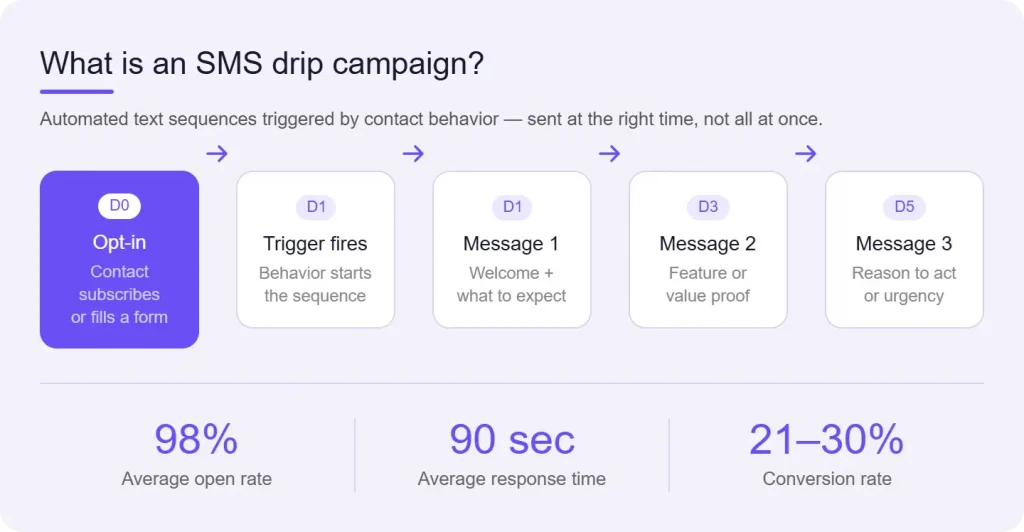
An SMS drip campaign is a pre-written series of texts that sends automatically based on what a contact does, opts in, abandons a cart, books an appointment, or goes quiet for 90 days. Each message fires on a defined trigger or time delay.
That’s what separates it from a broadcast.
A broadcast goes to everyone at once. A drip SMS campaign responds to individual behavior, sending messages only when a contact takes a specific action.
That’s what separates it from a broadcast.
A broadcast goes to everyone at once. A drip SMS campaign responds to individual behavior, sending messages only when a contact takes a specific action.
SMS Drip Campaign vs. Email Drip Campaign
SMS and email can both drip messages to your audience on autopilot. The difference is when to use one over the other, and getting that wrong costs you replies. Knowing where each one fits stops teams from using the wrong channel at the wrong stage.
| Factor | SMS Drip | Email Drip |
|---|---|---|
| Open rate | ~98% | ~20–25% |
| Average response time | ~90 seconds | Hours to days |
| Character limit | 160 characters | Unlimited |
| Best used for | Time-sensitive triggers | Nurture, content, detail |
| Compliance standard | TCPA (express written consent) | CAN-SPAM |
So, SMS wins on speed and visibility while email handles complexity and length. Cart abandonment, reminders, and expiring offers all require immediate delivery, which makes SMS the correct channel for these use cases. And an email cannot compete on response time.
The 4 Core Components of an Automated SMS Drip Campaign
Sequences fail at the setup stage, not the send stage. These 4 components determine whether a campaign runs clean or creates compliance and delivery problems from day one.
- Trigger: The action that starts the sequence. This could be a form submission, purchase completion, cart abandonment, or 60-day inactivity. Without a precise trigger, the sequence fires to the wrong contacts at the wrong time.
- Sequence logic: Covers the number of messages, send intervals, and branching rules. These 3 variables determine how the sequence runs. A contact who engages mid-sequence has changed status and should be routed differently.
- Exit condition:: An exit condition defines when a contact is removed from the sequence. Removal triggers include a purchase, a reply, or an opt-out. This is the most skipped step in sequence setup and directly causes contacts to receive follow-up messages after they have already converted.
- Validated contact list: Sending to unverified numbers means messages hit landlines, disconnected numbers, and VoIP lines that will never convert. That wastes the budget and increases TCPA liability from day one.
Types of SMS Drip Campaigns Every Business Should Know
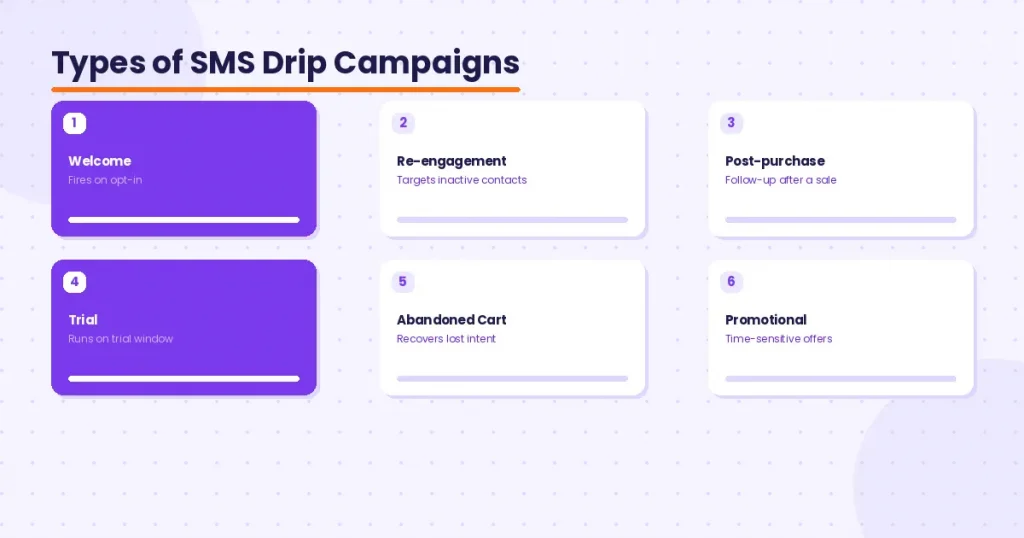
Not every sequence type fits every business. The use case determines the structure, as message count, timing, and exit logic all change depending on what the campaign is built to do.
1. Welcome and Onboarding Drip Sequences
Opt-in triggers the sequence. Message 1 confirms the subscription and sets expectations for what follows. The second and third messages cover substance: a feature worth knowing, how the product addresses a specific problem, or a single reason to take action. 3 to 4 messages are sufficient for this stage.
2. Abandoned Cart Recovery via SMS
Cart abandonment is typically caused by checkout barriers. A surprise fee, a forced login, or an overcomplicated checkout process interrupts the purchase before it completes.
3 messages over 24 to 48 hours address the issue without overloading the contact. The first text at 30 minutes contains only the cart link, no discount, and no artificial urgency. At 4 to 6 hours, a value-based offer goes out: free shipping, a guarantee, or a bundle. At 24 hours, a discount with a fixed deadline. If none of these 3 messages convert the contact, no additional messages in this sequence will.
3 messages over 24 to 48 hours address the issue without overloading the contact. The first text at 30 minutes contains only the cart link, no discount, and no artificial urgency. At 4 to 6 hours, a value-based offer goes out: free shipping, a guarantee, or a bundle. At 24 hours, a discount with a fixed deadline. If none of these 3 messages convert the contact, no additional messages in this sequence will.
3. Post-Purchase SMS Sequence
Buying is step one. Each message after it has one job: keep them informed, then ask for feedback once they've actually experienced what they bought. The review request goes out 2-3 days post-delivery as the contact needs direct product experience before providing a meaningful response. Extending the sequence beyond what is necessary increases opt-out rates without improving conversion.
4. B2B Lead Nurture SMS Drip
Triggers after a demo request or content download. 2 to 3 messages only. B2B contacts have low tolerance for frequent texts. Each message should answer one question or move toward one action, a call, a resource, or a next step.
5. Re-Engagement SMS Drip Campaign
Not every inactive contact is a lost cause, but most are. Send one message with a direct value offer and one follow-up if there is no response. After that, suppress them from the list. Retaining unresponsive contacts damages deliverability and increases spam complaint rates across every campaign that follows.
6. Appointment Reminder SMS Sequence
People forget. That's the whole problem this sequence solves. Confirmation when they book. A reminder the day before. A quick heads-up an hour or two out. Simple, and that's exactly why it works.
7. Product Launch SMS Drip Campaign
A product launch sequence runs across five messages at 48 to 72 hour intervals: teaser, feature reveal, launch day, social proof, and last-chance offer. The pacing is the strategy. A teaser before the launch generates early interest rather than dropping the announcement without context. The final offer converts only when the preceding messages have established sufficient context and intent.
SMS Drip Campaign: Step-by-Step Setup Guide
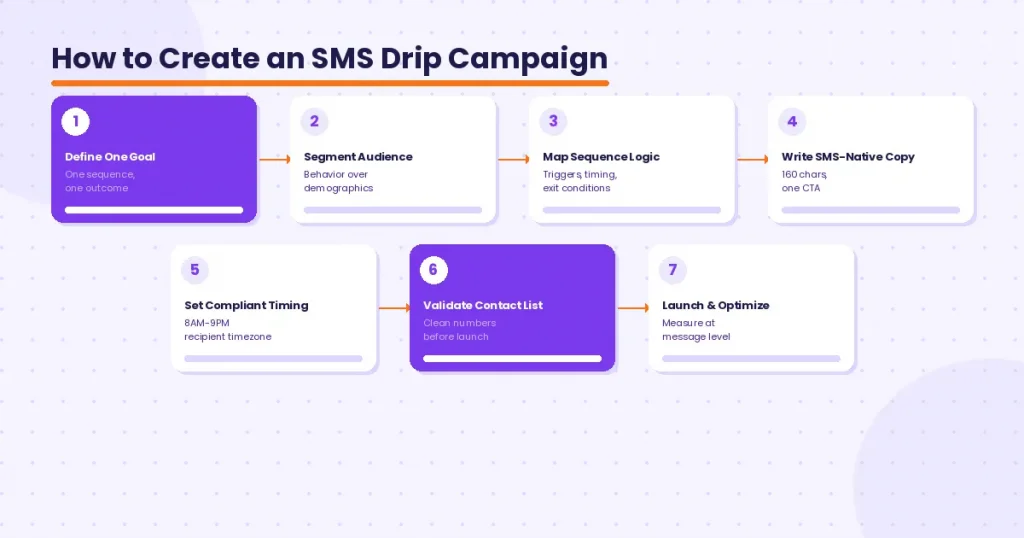
Sequence setup order directly impacts campaign performance. Teams that write copy before mapping sequence logic consistently build campaigns with broken exit conditions and compliance gaps. Follow this sequence.
Step 1: Define One Goal Per Campaign
Each campaign must target a single outcome. A cart recovery sequence recovers the carts. An onboarding sequence onboards. Mixing objectives within a single sequence reduces performance on both.
Step 2: Segment Your Audience Before Writing
Demographics identify who a contact is but do not indicate where that contact stands in the buying journey. Behavioral data does.
Segmenting by purchase history, signup source, and engagement patterns determines the correct message for each contact. A first-time subscriber requires different messaging than a contact with 6 months of inactivity.
Segmenting by purchase history, signup source, and engagement patterns determines the correct message for each contact. A first-time subscriber requires different messaging than a contact with 6 months of inactivity.
Step 3: Map the Sequence and Exit Conditions First
Map the complete flow before writing any message copy. This includes the trigger, the interval between messages, and the exit conditions. A contact who purchases mid-sequence exit immediately. A contact who replies, pauses the sequence for a human response. These rules must be defined before launch.
Step 4: Write SMS-Native Copy With a Single CTA Per Message
160 characters. One ask per message. Repurposed email copy fails in SMS - it's too long, too passive, and ignores the channel entirely. Write for someone reading on a phone screen in under five seconds.
Step 5: Set Compliant Timing and Send Windows
SMS marketing under TCPA is limited to 8 AM to 9 PM in the recipient's local time zone. Sending outside that window is a compliance violation, not just a bad practice. Send windows must be enforced at the platform level using the recipient’s timezone data.
Step 6: Validate Your Contact List Before Launch
Before any sequence goes live, run your list through ClearoutPhone. It validates numbers in bulk, identifies landlines, isolates disconnected contacts, detects line type (mobile, VoIP, landline), and surfaces timezone and location data for compliant send scheduling. Upload in CSV or XLSX. The validated list downloads in the same format, clean and ready to load into your SMS platform.
Sending to an unvalidated list means a portion of sequences fire to numbers that will never deliver. That wastes credits, pulls down delivery rates, and creates TCPA exposure from contacts that were never reachable to begin with. This is exactly the SMS budget protection problem. Companies burn through spending on unreachable numbers before the campaign earns a single open.
Sending to an unvalidated list means a portion of sequences fire to numbers that will never deliver. That wastes credits, pulls down delivery rates, and creates TCPA exposure from contacts that were never reachable to begin with. This is exactly the SMS budget protection problem. Companies burn through spending on unreachable numbers before the campaign earns a single open.
Step 7: Launch, Measure Per Message, and Optimize
Pull delivery rate, click rate, and opt-out rate at the message level, as campaign level averages do not indicate where sequences break down. If opt-outs spike on message three, that message is the problem. It could be the wrong timing, too many texts sent too fast, or a copy that does not match where the contact is in the journey.
SMS Drip Campaign Automation Best Practices
Running sequences without guardrails creates compounding problems: opt-out spikes, delivery failures, and compliance exposure. These practices prevent the most common ones.
1. Build Exit Conditions Into Every Trigger
A contact who converts mid-sequence must exit immediately. No exceptions. Sending a "last chance" copy to someone who has already purchased it is the fastest way to earn an opt-out.
2. Personalize Beyond the First Name
A first name in the subject line doesn't make a message relevant. Purchase history, discount behavior, and signup source do. ClearoutPhone's location and timezone data adds another layer of personalization. Sequences fire at the right local time for each contact, rather than running on a single fixed timezone.
3. How Many Messages Should Be in an SMS Drip Campaign
3 to 5 messages cover most use cases. Welcome: 3. Cart recovery: 2 to 3. Re-engagement: 2 maximum. Adding messages beyond the sequence's natural endpoint increases opt-outs.
4. How Often to Send Frequency Without Fatigue
One message per day is the maximum frequency during active sequences. Nurture campaigns should not exceed two to three messages per week. An opt-out rate increase of more than 1-2% on any single message indicates the frequency or content requires adjustment.
5. Keep Your Contact List Clean Before Any Sequence Goes Live
Use ClearoutPhone to validate phone numbers across 248+ countries, confirm line type, and remove disconnected contacts before they enter your sequences. Validated contact data makes sure sequences reach active mobile numbers. It helps maintain delivery rates and TCPA compliance status across every campaign.
6. Track Opt-Out Rate At The Message Level
Overall opt-out rates mask the real problem. A 0.5% campaign level opt-out rate can conceal a 3% opt-out on a single message. That message requires immediate review and adjustment.
Best 5 SMS Drip Campaign Examples
Real sequence structures with message timing, copy direction, and exit conditions. The copy can be adapted to any product or audience, as the underlying logic applies across industries.
1. Abandoned Cart Recovery - E-commerce
Trigger: Cart abandoned with no purchase after 30 minutes.
Message 1 (30 min):
Message 1 (30 min):
"Hey [Name], you left something behind. Your cart is saved: [link]. Items sell out fast."
Message 2 (4–6 hours):
"Still thinking it over? Here's 10% off to make it easier. Expires in 24 hours: [link] Reply STOP to opt out."
Message 3 (24 hours):
"Last chance - your discount expires tonight: [link]."
Why this works: 3 messages over 24 hours with an escalating offer consistently outperform a single reminder. The first message creates urgency without pressure. The second addresses the barrier preventing purchase completion. The third closes with a hard deadline.
Exit condition: Purchase completed.
Exit condition: Purchase completed.
2. SaaS Free Trial Nurture
Trigger: Trial account created.
Message 1 (Within 5 min):
Message 1 (Within 5 min):
"Your [Product] trial is live. Start here: [setup link]. It takes under 5 minutes."
Message 2 (Day 3):
"[Name], teams using [Feature X] cut [specific outcome] by 30%. Here's how: [link]."
Message 3 (Day 6):
"Your trial ends in 2 days. Upgrade now and keep everything you've set up: [link]."
Why this works: The sequence runs on the trial window, rather than a fixed schedule. Day 1 addresses setup friction before it becomes a reason to drop off. Day 3 shows value before doubt sets in. Day 6 introduces urgency before the trial expires.
The sequence stops when the contact upgrades.
The sequence stops when the contact upgrades.
3. Real Estate Lead Follow-Up
Trigger: Inquiry submitted on property listing.
Message 1 (Within 5 min):
Message 1 (Within 5 min):
"Hi, thanks for checking out [Property]. I'm [Agent Name] available to answer your questions related to the property.
Message 2 (24 hours):
"Quick follow-up on [Property Address]. Happy to send the full listing details or you can also schedule a call with me. Let me know what works for you?"
Message 3 (72 hours):
"The listing at [Address] is still available. A few similar properties just came on, worth a look? [link]"
4. Healthcare Appointment Reminder
Trigger: Appointment booked.
Message 1 (At booking):
Message 1 (At booking):
"Confirmed: [Patient Name] at [Clinic] on [Date] at [Time]."
Message 2 (24 hours before booking):
"Reminder: Your appointment at [Clinic] is scheduled for tomorrow at [Time]. Want to reschedule? Call [number]."
Message 3 (2 hours before):
"Your appointment time is [Time]. See you soon."
5. Win-Back Campaign - Inactive Subscribers
Trigger: No engagement in 90 days.
Message 1:
Message 1:
"Hey [Name], it's been a long time we've haven't seen you. Let's meet in our 15% Off sale. Live for 48 hours: [link]."
Message 2 (48 hours):
"Last chance! You are missing on our biggest sale. Ending at midnight. [link]”
Why this works: Win-back campaigns perform because the audience has prior brand exposure. Results depend entirely on list quality. Unvalidated numbers do not just fail to convert, they consume send credits with zero return.
Contacts who purchase exit the sequence immediately. Contacts who do not respond after message two are suppressed from the list.
Contacts who purchase exit the sequence immediately. Contacts who do not respond after message two are suppressed from the list.
What Platform Should You Use for SMS Drip Campaigns?
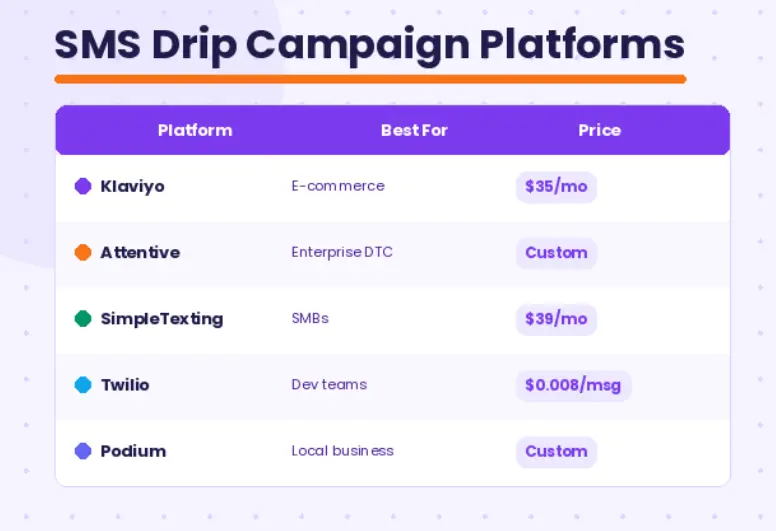
Most platforms handle the basics. Sequence builder, scheduling, opt-out management, and analytics. Differences show up in compliance tooling, API depth, and integration flexibility. Here's a quick breakdown to start your evaluation, platform selection at scale warrants a dedicated comparison based on your volume and stack.
| Platform | Best For | Key Feature | Starting Price |
|---|---|---|---|
| Klaviyo | E-commerce | SMS + email unified flows | $35/mo |
| Attentive | Mid-market to enterprise DTC | AI-powered personalization | Custom (typically $500–$2K+/mo) |
| SimpleTexting | SMBs | Fast sequence builder, 3 user seats | $39/mo |
| Twilio | Developer teams | Full REST API, pay-per-message | $0.0083/message |
| Podium | Local businesses | Reviews + SMS combined | Custom (quote-based) |
None of these validates your contact list before sequences launch. That's a separate step; run your list through ClearoutPhone before importing it into any platform.
Key Features to Evaluate in an SMS Automation Platform With Drip Campaigns
These are the features that separate a platform that runs clean sequences from one that creates compliance and delivery problems at scale.
- Behavioral triggers fire on contact action rather than time delay alone.
- Exit condition controls automatically remove contacts on purchase or reply.
- Timezone-based send windows enforce TCPA compliance by recipient location.
- Message-level A/B testing evaluates copy and timing per message rather than subject lines alone.
- Automatic stop handling opt-outs process immediately without requiring manual intervention.
- Pre-launch list validation Use ClearoutPhone before import into any platform.
Here's a breakdown of top SMS marketing platforms and what to look for when making your decision.
Wrap Up
SMS drip campaigns work when 4 things are in place: a clean contact list, a compliant setup, tight sequence logic, and copy written for 160 characters. Most failed campaigns skip at least one of those. Opt-out rates and delivery failures reflect exactly which one.
Before any sequence goes live, run your list through ClearoutPhone. It validates numbers in bulk across 248+ countries, filters landlines and disconnected contacts, confirms mobile line type, and returns timezone data for compliant send scheduling. Teams that validate before launch cut up to 40% in wasted messaging costs and maintain 99.73% accuracy on every campaign.
Before any sequence goes live, run your list through ClearoutPhone. It validates numbers in bulk across 248+ countries, filters landlines and disconnected contacts, confirms mobile line type, and returns timezone data for compliant send scheduling. Teams that validate before launch cut up to 40% in wasted messaging costs and maintain 99.73% accuracy on every campaign.
FAQs
1. What is an SMS drip campaign?
A set of automated texts triggered by contact behavior, opt-in, cart abandonment, purchase, and inactivity. Each message fires on a defined trigger or time delay without manual sends.
2. Is SMS drip marketing legal in the US?
Yes. Get written consent from every contact, tell them what they're signing up for, and always include a STOP option. Missing any of these can cost up to $1,500 per text in TCPA fines.
3. How do I create an SMS drip campaign for my business?
Each campaign requires a single defined goal. The contact list must be segmented before a copy is written. Sequence logic and exit conditions can be mapped first, followed by timezone-compliant send windows. The contact list is validated with ClearoutPhone before launch. Post-launch, opt-out and delivery rates can be tracked at the message level.