Phone Validation for E-Commerce: Stop Bots and Promo Abuse
TL;DR
- If your phone field validates only the format, a bot could claim a welcome offer and enter your system.
- Disposable and VoIP numbers are cheap and quick to get, so a person or bot can keep signing up for the same discount.
- Validate the number at signup to block fake accounts, then again at checkout so that guest orders can’t slip through with the code.
- ClearoutPhone shows you if a number is mobile, landline, VoIP, or disposable, and whether it’s active right now.
You’ve probably launched a welcome offer that looked like a success. Signups went up and codes were redeemed, but you still had to wonder: Were these real customers?
That’s where things get tricky. A phone number may pass a format check, but disposable and VoIP numbers let one person open account after account.
That’s where a phone validation tool helps e-commerce brands facing this. It checks whether a number is real, what line type it has, and whether it’s active before an account or discount exists.
In this guide, we’ll break down why e-commerce needs phone validation and how to build the workflow.
Table of Content
Why does e-commerce need phone validation for signup abuse
E-commerce needs phone validation because email addresses are free to create in bulk, while active mobile numbers are not. Validation turns the phone field into a check against repeat signups.
Disposable numbers and repeat signups
Disposable phone numbers are temporary numbers from online services. They stay active long enough to receive an OTP, then expire or get passed on to someone else.
The tricky part is that a basic check won't flag them. It was issued and registered. So it comes back as a valid mobile number. A person can do this a bunch of times and get the same first order discount repeatedly.
Formatting produces a similar void. If you don't convert all entries to E.164, your system might think +1 415 555 0134, 4155550134, and (415) 555-0134 are three customers.
Promo abuse by bots
Bots can complete a signup form in seconds. They usually use the email addresses from VoIP pools or number generators and use the welcome code on each new account.
Number generators give numbers that pass a format check, but are not associated with an active real line. It looks like customer growth on your dashboard. It is one script, with the same offer.
You will see this in the numbers: high volume of sign-ups, high promo redemption, and very few second orders coming from those accounts.
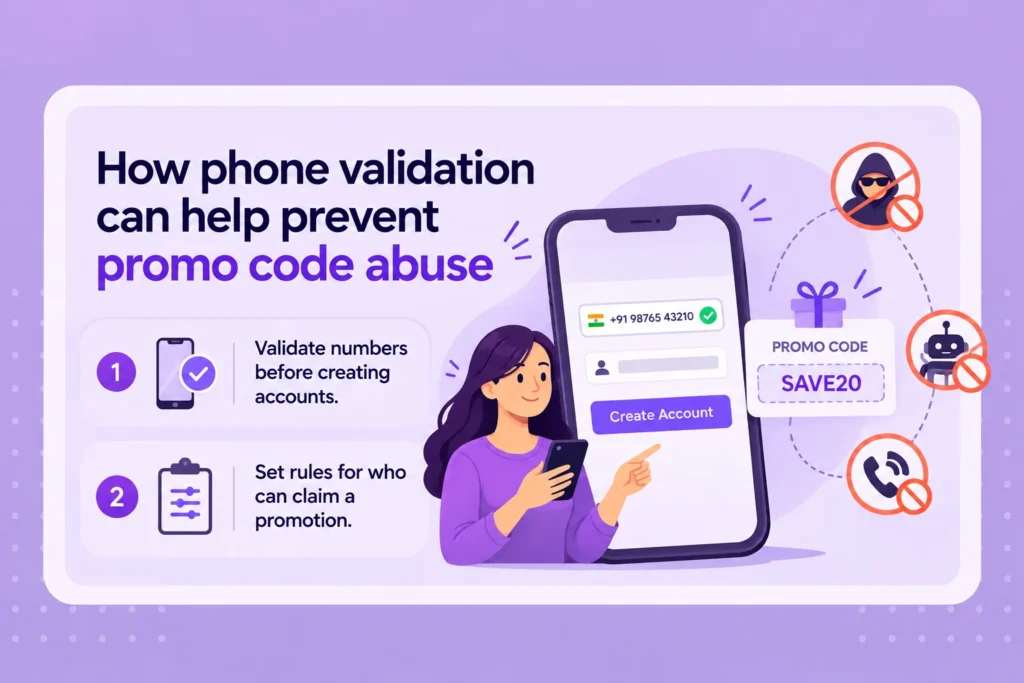
How phone validation can help prevent promo code abuse
Phone validation prevents promo code abuse by checking each number before the account exists, then tying every promotion to one validated mobile number that an abuser cannot replace.
That's the best way to stop coupon abuse signups, since the offer no longer depends on an email address anyone can create for free.
Validate numbers before creating accounts
Validate the number as soon as the customer submits it, before the account is created. If it's invalid, disposable, or not a mobile line, ask for a different number right there.
Since nothing has been created yet, there's no fake account to clean up later.
Set rules for who can claim a promotion
Validation tells you what the number is. Your eligibility rules decide what that number gets. A few rules cover most promo abuse prevention needs:
- One offer per mobile number: Make sure that the E.164 version of the number has not been redeemed in the past, before applying the code.
- Mobile-only eligibility: Welcome offers aren't available for mobile-only numbers, although they can be bought at full price.
- Hold rather than reject: If the result is ‘uncertain’, create the account without a discount and release it when the customer passes OTP.
That's how to prevent promo code abuse in e-commerce without turning away real buyers. The account stays open, and only the incentive is protected.
Should phone validation happen at signup or checkout
It should happen at both. Phone validation at signup stops fake accounts from being created, while phone validation at checkout protects the discount and delivery when an order is placed.
| Signup validation | Checkout validation |
|---|
| What it stops | Fake and repeat accounts | Promo codes redeemed through guest checkout |
| What it runs | Before the account is created | Before the discount is applied and the order is confirmed |
| What it protects | Your customer database and OTP spend | Your margin on discounted orders and delivery contact |
Signup validation
Signup is where the bots, number generators and disposable numbers get filtered out before they become accounts. It also means that you can reach every number in your customer database for order updates, SMS campaigns and support.
Validate checkout
Guest checkout skips signup entirely. If your welcome code works at checkout, then abusers can use your code without creating an account.
Phone validation at checkout bridges that gap. Enter the promo code, validate the number, and apply your eligibility rules before confirming the discount.
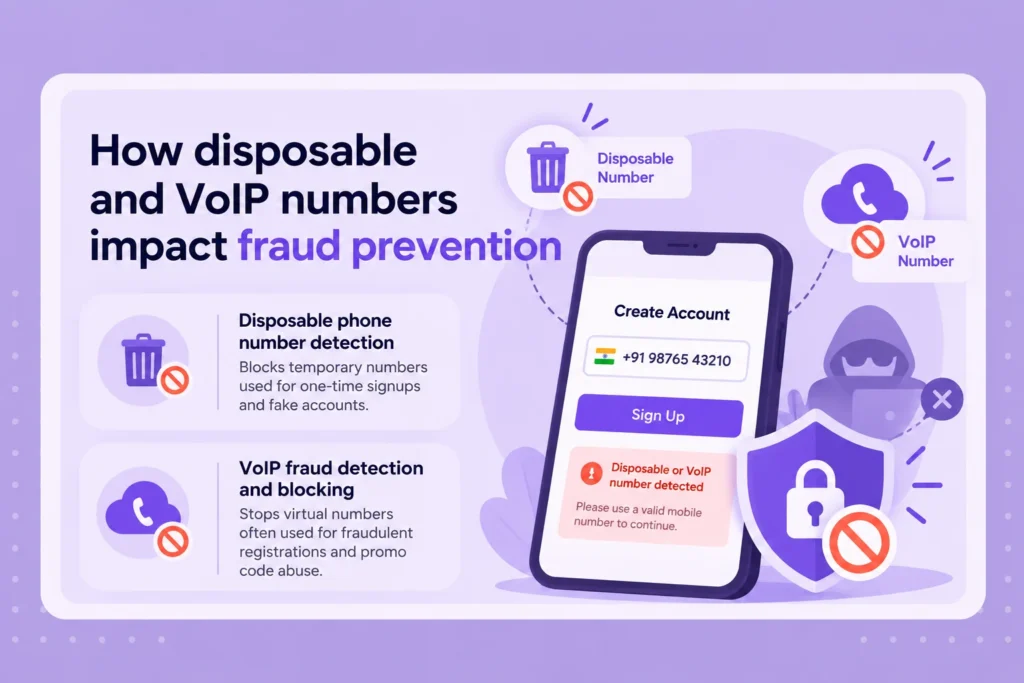
How the disposable and VoIP numbers impact fraud prevention
Disposable and VoIP numbers can make one person appear as many customers. They can often receive an OTP, so catching them is about line type detection and not format checking.
For fraud prevention in e-commerce signup flows, that comes down to 2 checks.
Disposable phone number detection
Disposable phone number detection needs a real-time check. Because these numbers were issued by a real provider, a registry lookup alone won't separate them from regular mobile lines.
ClearoutPhone's Smart Validation runs a real-time telecom query and flags disposable numbers with its line type result.
VoIP fraud detection and blocking
VoIP numbers can be set up online in bulk, often with more than an email address. That makes them easy to use for repeated signups.
They're also harder to classify than they look. A VoIP number can appear as mobile in telecom databases if it was first issued as a mobile line or if porting records haven't caught up.
That's why VoIP detection for fraud needs a real-time query instead of a static lookup. That said, their blocking should be targeted. Some genuine customers use VoIP numbers for work or privacy. Keep them out of welcome offers, but let them buy at full price.
Where does OTP verification fit into phone validation
OTP verification comes after phone validation. Validation confirms the number is real, active, and mobile, then OTP confirms the person signing up controls it, so no SMS code is wasted.
Phone validation before OTP
SMS is billed per attempt. Sending a code to a landline, an invalid number, or a disposable number costs money and gives you nothing back.
Validating first also helps the customer. They can fix a typo straight away instead of waiting for a code that never arrives. Our guide on preventing OTP delivery failures covers this in more detail.
OTP as an additional verification layer
Validation can't tell you who is holding the phone. OTP fills that gap by asking the customer to enter a code sent to the number.
It's worth the extra step for new accounts claiming a welcome offer and for results that came back uncertain.
What’s the best signup prevention workflow for bots
Ideally, the number should be checked before the form is submitted as per the line and carrier type, and allow the promotion if all of the checks are passed.
If a number is not appropriate for a rule, the customer is asked for another number.
Number validation before submission
Run the check on the phone field itself, before the submit button creates anything. Bots using generated or disposable numbers get stopped here, and a real customer with a typo can fix it on the spot.
Risk-based signup decisions
For bot signup prevention in e-commerce, not every result needs the same response. Here's how each validation result can map to an account and promotion decision:
| Validation result | Account | Welcome promotion |
|---|
| Valid, active mobile | Create | Grant, after OTP if your rules require it |
| VoIP | Create, or ask for a mobile number | Withhold |
| Landline | Create, or ask for a mobile number | Withhold |
| Disposable | Ask for a different number | Withhold |
| Invalid | Ask the customer to correct it | Withhold |
Account and promotion eligibility
Create the account first, then check promotion eligibility as a separate step.
Before the offer is granted, confirm that:
- The number hasn't claimed this offer before.
- The customer has passed OTP, if your rules require it.
How does ClearoutPhone support e-commerce phone validation
ClearoutPhone validates numbers as you sign up and checkout by detecting mobile, landline, VoIP and carrier, and makes sure that the phone numbers are active before they qualify for a promo.
Real-time phone validation
Check if the customer is on the form. ClearoutPhone's API returns results in less than 200ms. All responses include status, line type, carrier, E.164 format, country and timezone. The API works with cURL, PHP, Java, Node.js, Python, C and Go.
Mobile, landline, VoIP identification
The line type lookup can be used to see if a number is mobile, landline or VoIP. You can enable ClearoutPhone Smart Validation to flag disposable numbers. Review and download validation results
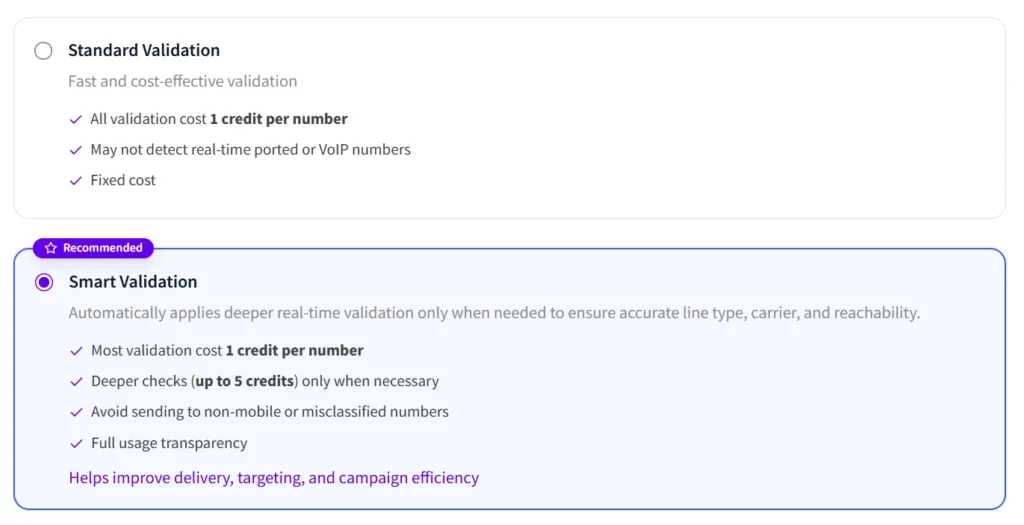
ClearoutPhone's web app lets you review validation history and download results. In “My Lists,” you can view number breakdowns for Standard and Smart validation modes.
Reachability checks
The standard validation will verify that the number has been issued and registered. It does not assure that the number is active today.
Smart Validation is an additional real-time telecom query to make sure that the
number is active at the moment. The deeper check, which can be up to 5 credits, is only performed on recently ported lines, VoIP numbers and numbers in uncertain carrier data ranges. It is disabled by default and can be enabled in your account settings.
What should e-commerce businesses measure after adding phone validation
Track the number of risky signups that phone validation prevents. Take a note of each metric prior to the starting validation so that it becomes easy for comparison.
| Metric | Why track it | How to calculate |
|---|
| Suspicious signup rate | Shows how much of your signup traffic validation is flagging | Flagged signups ÷ total signup attempts |
| Disposable-number rate | Shows how often abusers rely on temporary numbers | Disposable results ÷ numbers validated |
| VoIP signup rate | Shows how much VoIP traffic your rules need to handle | VoIP results ÷ numbers validated |
| Promo redemption rate | Shows whether redemptions drop once fake accounts are filtered | Promo codes redeemed ÷ new accounts |
| Promo-to-purchase rate | Shows whether promo users go on to buy again | Promo users with a second order ÷ promo users |
| Repeat signup attempts | Shows how often the same number tries to sign up again | Attempts with an already-used number ÷ total signup attempts |
| Signup rejection rate | Shows whether your rules are too strict for real customers | Signups asked for another number ÷ total signup attempts |
Key point: Check first, then give the incentive
Promo abuse control only works when the system checks the details. Phone checks for online stores can confirm the line type and the current status before any account is created or any discount is applied.
Make these first steps:
1) Verify the phone field with ClearoutPhone in the form.
2) Allow one welcome offer per mobile number.
3) Send the OTP only after the number passes validation.
That way, your promos land with the customers they were meant for.
Stop risky signups early to reduce promo misuse. ClearoutPhone screens phone numbers at both signup and checkout, so welcome offers go to real users with working mobile numbers.
Validate signups with ClearoutPhone
FAQ
1. Can phone validation identify VoIP numbers? Yes. A line type lookup shows whether a number is mobile, landline, or VoIP. Some VoIP numbers are listed as mobile in telecom databases, so ClearoutPhone's Smart Validation uses a real-time query to classify them correctly.
3. Is phone validation better at signup or checkout? It works best at both. Signup validation stops fake accounts before they're created, while checkout validation covers guest checkout and protects discounts. If you can only add one, start where your welcome code is redeemed.