• Resource
      SUPPORT
    • Getting started
    • Why ClearoutPhone?
    • Carrier Lookup
    • Phone Line Type Lookup
    • Enterprise
    • API Documents
    • BLOGS
    • HLR Lookup Explained: What It Shows Beyond Phone Validation
    • TCPA Compliance and Phone Data: What Marketers Miss
    • View All Blogs
  • Integrations
  • Pricing
  • Developers
  • Login
REQUEST FOR DEMO
Akanksha Mishra / October 12, 2026 October 12, 2026

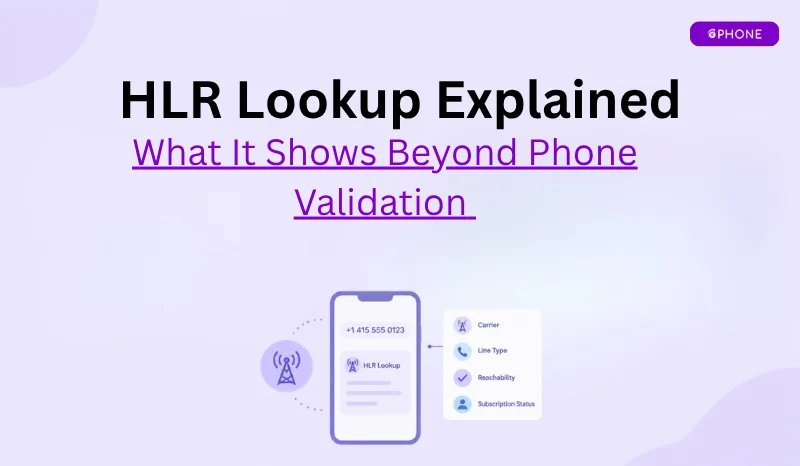
HLR Lookup Explained: What It Shows Beyond Phone Validation


HLR Lookup Explained: What It Shows Beyond Phone Validation

Basic phone validation checks if a number looks valid, but it doesn't tell you everything about its current network status. An HLR lookup goes a step further by checking what the mobile network reports about that number.

An HLR lookup queries the mobile network for information about a subscription. It can return details such as the carrier, subscription status, and network registration information.

In this article, you'll learn how HLR lookup works, how it differs from basic phone validation, and when it can be used.

Table of Content


‣ What is an HLR Lookup?
‣ How does an HLR Lookup work?
‣ What does an HLR lookup provide?
‣ HLR Lookup vs. Phone Number Validation
‣ When to use HLR Lookup?
‣ How does HLR Lookup check phone number reachability?
‣ How does ClearoutPhone Smart Validation automate deeper phone checks?
‣ Is HLR lookup real-time?
‣ FAQ
What is an HLR Lookup?


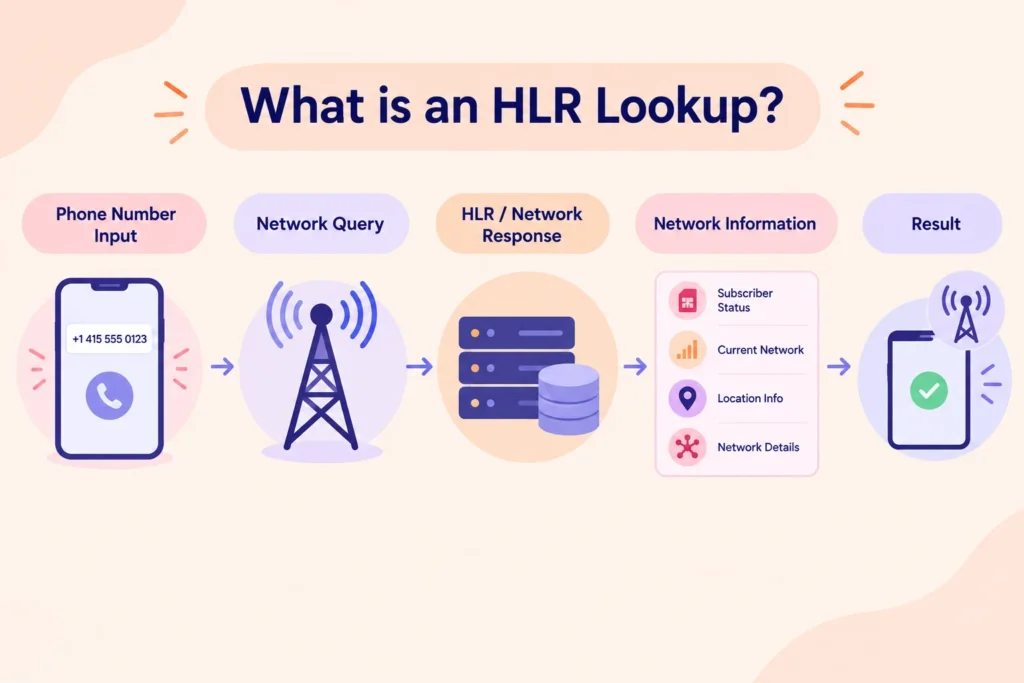
HLR lookup process from phone number to network information

Home Location Register (HLR) is a telecom signaling query that requests information from a mobile network for a phone number.

The lookup does NOT send or receive a call or text to the phone number. Rather, it asks the mobile network to fetch information related to this subscription, including carrier information, network status, roaming status, and the mobile phone number's status on the network.

It's a term from the older mobile network architecture. In 4G networks, new networks may involve an HSS system, while in 5G, new networks may involve a Unified Data Management (UDM) architecture. However, "HLR lookup" remains the commonly used industry term.

How does an HLR Lookup work?


Here's how HLR lookup works:

1. Phone number entered: The lookup service takes the phone number, usually in international E.164 format, and uses this to work out which mobile network is relevant.

2. Telecom query sent: The provider sends a signaling query over its telecom interconnect. The query asks for information related to the subscription without calling the number or sending an SMS.

3. The query is sent to the appropriate network: The request is sent to the network that is currently associated with the subscription. The reason number portability matters here is that the current carrier may not be the same as the carrier that originally assigned the number.

4. Network returns a response: The network may return registration or routing information, or an error if the requested data is unavailable.

5. Response interpreted: The HLR lookup provider receives the network response and displays the relevant information such as carrier or network status. Because this is the network's response at the time of the query, it should be treated as a point-in-time result.

What does an HLR lookup provide?


An HLR lookup can provide information about the network that a phone subscription is currently associated with, including carrier and registration-related information.

Carrier details


The prefix or numbering range of a phone number can be used to determine which carrier the number range was originally assigned to. If the number was ported later on, the information may not correspond to its current carrier.

But the current mobile-network relationship can be queried by an HLR carrier lookup. This gives more meaning to carrier information when numbers have moved between networks.

Network registration status


The response tells if the subscription exists on the network and whether it is currently registered or temporarily unavailable. But that doesn’t mean the person will answer a call or read a message. It’s just saying what the network is reporting about the subscription at this moment.

Routing information


To deliver communications to the correct network and serving system, mobile networks require routing information.

An HLR query can return the routing-related information without sending anything to the handset.

Phone intelligence and line type


HLR data can tell you information about the network, but doesn’t determine if a number is landline, mobile, or VoIP by itself.

Line type classification is performed by separate phone intelligence, and can be improved with carrier and network data to build a clearer profile of the number.

For instance, a number can have an identifier for the current carrier and a different identifier for the line type, mobile, landline, or VoIP. These are unique characteristics and thus should be assessed separately when evaluating the use of a number.

HLR Lookup vs. Phone Number Validation


Let’s compare basic phone number validation with HLR Lookup to see what each method checks and when it’s useful.

Basic phone validationHLR Lookup
Checks number structure and formatQueries mobile-network information
Uses numbering and phone-data sourcesUses a telecom signalling query
Can identify basic number informationCan identify current network information
Useful for routine phone data checksUseful when network-level information matters
Does not query the mobile network in the same wayQueries the network associated with the subscription
Reachability is based on available phone data.Can provide a point-in-time network registration signal
May rely on numbering or portability dataCan reflect the network currently associated with the subscription

These two checks help in different ways, so they do not replace each other.

When simple validation is sufficient


Basic phone validation is enough when all you need to check is the phone number format, numbering information, and available phone-data attributes. This is often sufficient for routine list screening and database clean-up, where the current state of the network does not affect the workflow.

When to use HLR Lookup?


An HLR lookup isn't necessary for every phone number.

Basic phone checks may give you enough information for routine database cleanup. A deeper lookup is more useful when the number is of higher value, has uncertain data, or when a workflow depends on carrier information.

High-value leads


A phone number connected to a high-value lead may be worth a deeper look before outreach. If the basic result leaves some doubt as to the carrier or current network status, an HLR lookup can provide another data point before the number is handed off to a calling workflow.

This is especially useful if the cost of a failed contact attempt is greater than the cost of the additional check.

Uncertain phone numbers


Some numbers return conflicting or incomplete information across phone-data sources. Running a deeper telecom query can help resolve uncertainty around the current network relationship. The result should still be treated as a current network signal.

Carrier-dependent outreach


Carrier information is important for campaign logic, message routing, and carrier-dependent pricing.

An HLR carrier check can return data on the network that a subscription is currently connected to, not just from the network that it was originally assigned to.

Current network status counts


An HLR lookup provides a point-in-time view of the subscription's reported network registration status.

It can also help identify the current carrier for a number that has been ported from its original network.

How does HLR Lookup check phone number reachability?


The lookup receives a response from the relevant mobile network about the subscription. Depending on the network and lookup route, that response can provide a registration-related or reachability signal.

This is a network-level signal. It does not confirm that the person will answer a call, read an SMS, or remain reachable after the lookup.

How to interpret the HLR response?


A positive response indicates that the subscription is registered with a network. Other responses include "unknown subscriber" and "subscription unavailable for a particular service at this time.” These answers require some context. Of course, this does not mean that the subscription is inactive forever, since the network status may change.

The phone can lose coverage, turn off, change networks or be in a temporary service condition. You can also port numbers between carriers. Therefore, the result of an HLR should not be taken as a permanent guarantee of reachability.

How does ClearoutPhone Smart Validation automate deeper phone checks?


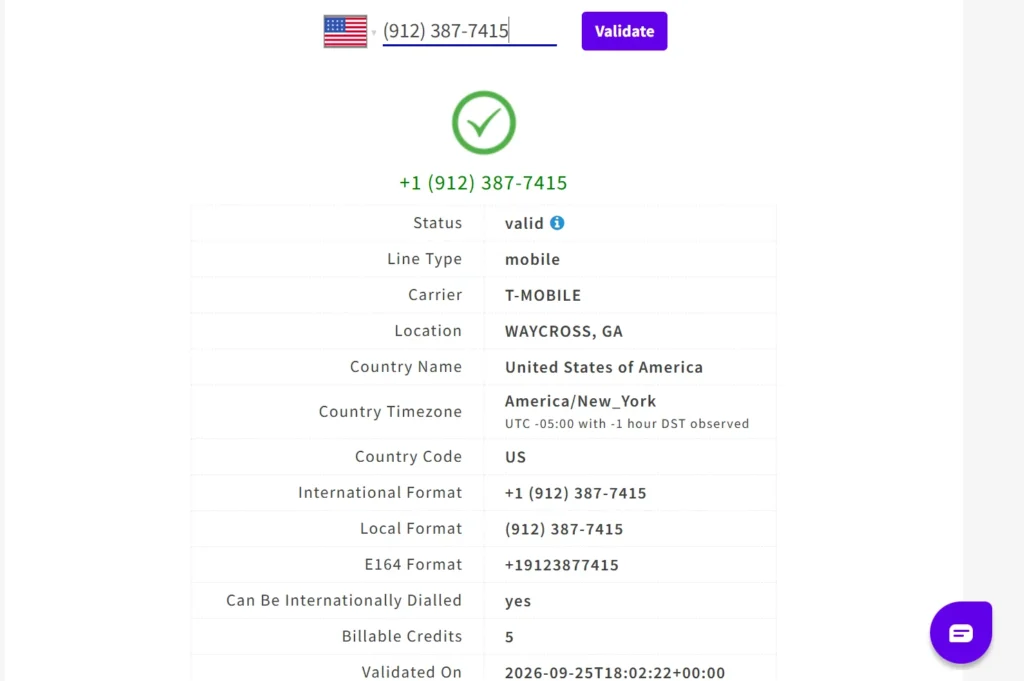
ClearoutPhone's Smart Validation goes beyond standard phone validation by combining phone number validation with telecom-level checks. In addition to validation, it can provide carrier information, line type, time zone, and the location the number is from.

This gives businesses more context about a phone number than format validation alone.

Standard checks first


The workflow starts with standard phone-data checks. This helps identify common issues and provides basic information about the number. For many numbers, these checks provide enough information for the next step.

Deeper checks next


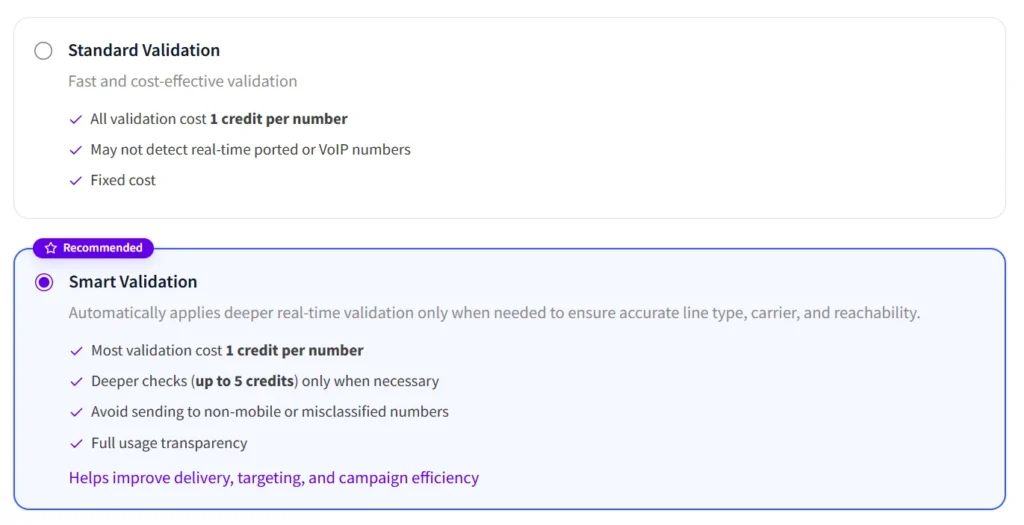
Smart Validation and Standard Validation comparison in ClearoutPhone.

When confidence is low on a number, Smart Validation runs an additional real-time telecom query. It provides deeper carrier information, network-level reachability signals, and additional telecom intelligence beyond standard validation.

Carrier, line type, and reachability


Phone validation results showing carrier and line type.

The value comes from combining different signals. Carrier information identifies the associated carrier. Line-type information helps distinguish mobile, landline, VoIP, and other number types. The deeper telecom query can also provide a current network-level reachability signal.

Together, these checks provide more context than basic phone validation alone.

Get deeper phone intelligence with Smart Validation

Is HLR lookup real-time?


Yes, an HLR lookup probes the mobile network at the time of the lookup, and not just a stored phone-data record. The response depends on the destination network, query route, and information available.

Since the result is obtained from an external network query, response time may vary from lookup to lookup.

If a standard phone check leaves uncertainty, a real-time network query can provide additional carrier, registration, and reachability information prior to outreach. This is where the deeper check comes in handy when the first result doesn’t give you enough confidence to move on.

If a normal phone check still leaves you unsure, a real-time telecom query with ClearoutPhone can add more details about whether the number looks reachable.

Try ClearoutPhone For Free

FAQ


1. What is HLR lookup?
An HLR lookup is a request in telecom signaling. It checks what a mobile network knows about phone subscriptions. You can get carrier details, registration status, details on routing and that too without calling or texting the number.
2. Can HLR Lookup detect Line type?
HLR itself should not be considered an independent source validating line types. A phone-data service can combine network data associated with HLRs with line-type intelligence to determine if a number is VoIP, landline, mobile, or some other type of classification.
3. Does HLR Lookup guarantee reachability?
No. The HLR result does not guarantee that a call will be answered, a message will be read or that the person will remain reachable after the lookup.
4. Does an HLR lookup call or text the number?
No. An HLR lookup queries network information about the subscription. It doesn't place a call or send an SMS to the phone number being checked.

Search

Recent Posts

  • HLR Lookup Explained: What It Shows Beyond Phone Validation October 12, 2026
  • TCPA Compliance and Phone Data: What Marketers Miss August 27, 2026
  • SMS List Fatigue: Why Subscribers Stop Responding July 31, 2026
  • Prevent OTP Delivery Failures and Improve User Onboarding June 30, 2026
  • SMS Drip Campaigns: The Complete Guide for 2026 June 3, 2026

Phone Validation Service

Reach out to more real customers for your business

Create a free account with 100 credits

Company

Contact

Careers

Affiliates

Status

ClearoutPhone

Why ClearoutPhone?

Pricing

Feature

FAQ

Resources

Integration

API & Documentation

Blog

Help

Legal

Privacy Policy

Terms & Conditions

Security

 ISO 27001/2022

Products

Carrier Lookup

Phone Line Type Lookup

Email Verifier

Email Finder

Form Guard

Prospect

LinkedIn Email Finder

© 2026 ClearoutPhone - All Rights Reserved Powered by Clearout Inc.

Disclaimer: ClearoutPhone may contain links to third-party websites or resources. In no event shall we be liable to third parties availability, accuracy, the related content, products, services or any special, punitive, incidental, indirect or consequential damages of any kind, or any damages whatsoever, including, without limitation, those resulting from loss of use, lost data or profits, or any liability, arising out of or in connection with the use of this third-party software.

💰 Stop wasting SMS credits: Use Smart Validation to identify active status before you send. View Smart Validation →
x